


Learn through the super-clean Baeldung Pro experience:
>> Membership and Baeldung Pro.
No ads, dark-mode and 6 months free of IntelliJ Idea Ultimate to start with.
Last updated: July 22, 2024
Learn through the super-clean Baeldung Pro experience:
>> Membership and Baeldung Pro.
No ads, dark-mode and 6 months free of IntelliJ Idea Ultimate to start with.
In this tutorial, we’ll explore two authentication techniques: basic and digest.
Furthermore, we’ll present the main differences between them.
Basic authentication is a simple authentication method that uses HTTP. Let’s take a look at the steps of the HTTP basic authentication process:
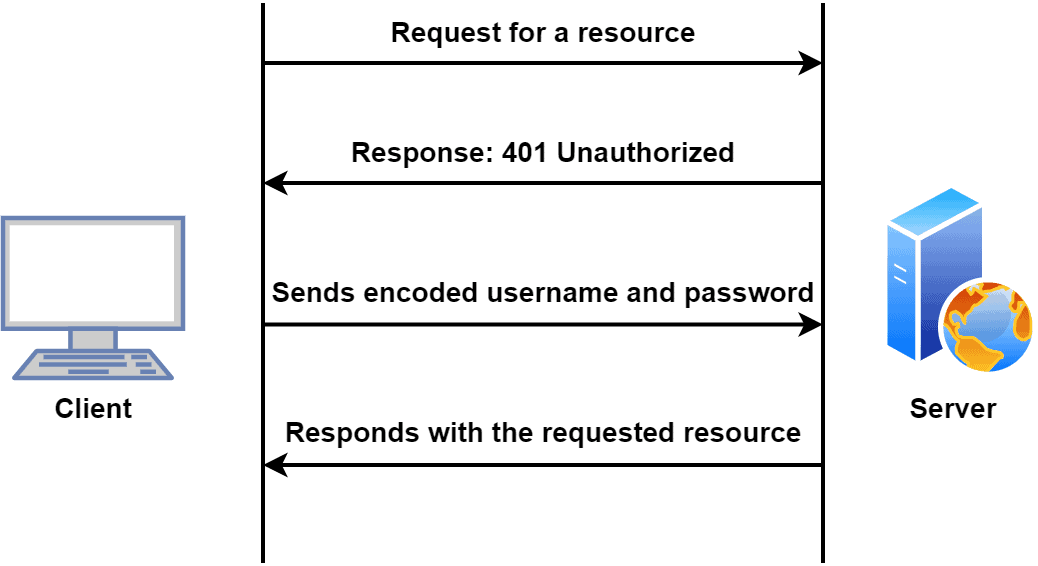
Let’s consider a scenario when a client requests to download a file from a server. The first step is to send a request to the server using HTTP. As soon as the server receives the request for a particular file, it responds in two ways. First, the server may grant the request and provide access to the file.
Alternatively, if the requested file requires authentication, the server responds with an HTTP status code. One such code is 401, which means unauthorized access.
When the client receives the status code, the user is asked to provide the username and password. Upon receiving the username and password from the user, the client encodes the information using the Base64 method. Finally, the client sends another request, including the encoded credentials.
Furthermore, upon receiving the encoded credentials, the server utilizes the Base64 method to decode the original credential. Moreover, the server verifies the decoded credentials with its dataset. After a successful verification, the server responds with the request file. On the other hand, if the verification isn’t successful, the server sends an HTTP status code.
The main advantage of the basic authentication method is its simplicity. It’s easy to implement. Additionally, compatibility is another advantage, as most HTTP clients and web browsers support it.
Furthermore, the client sends the authentication information in a header file to the server. Therefore, the basic authentication methods don’t depend on cookies or sessions.
Finally, the server authenticates each request received from the server independently. Therefore, the authentication process is stateless. Hence, we need only one call to the server to access the requested file and authenticate it. As a result, the basic authentication method is faster than modern authentication methods.
Now, let’s discuss some disadvantages of the basic authentication method.
It utilizes the Base64 method for encoding the credentials. However, the lack of encryption makes the credentials suspectable to cyber attacks such as replay attacks. Additionally, the basic authentication method doesn’t use a secure transmission channel. Therefore, cyber attackers can easily intercept and decode the credentials from the transmission channel.
Furthermore, the basic authentication method doesn’t support complex password policies, making it vulnerable to brute-force attacks.
An alternative to the basic authentication method, the digest authentical method provides security while transmitting data. It contains the hashing technique to safeguard the credentials while transmitting. Additionally, it ensures the data integrity.
Now, let’s explore the steps in the digest authentication method:
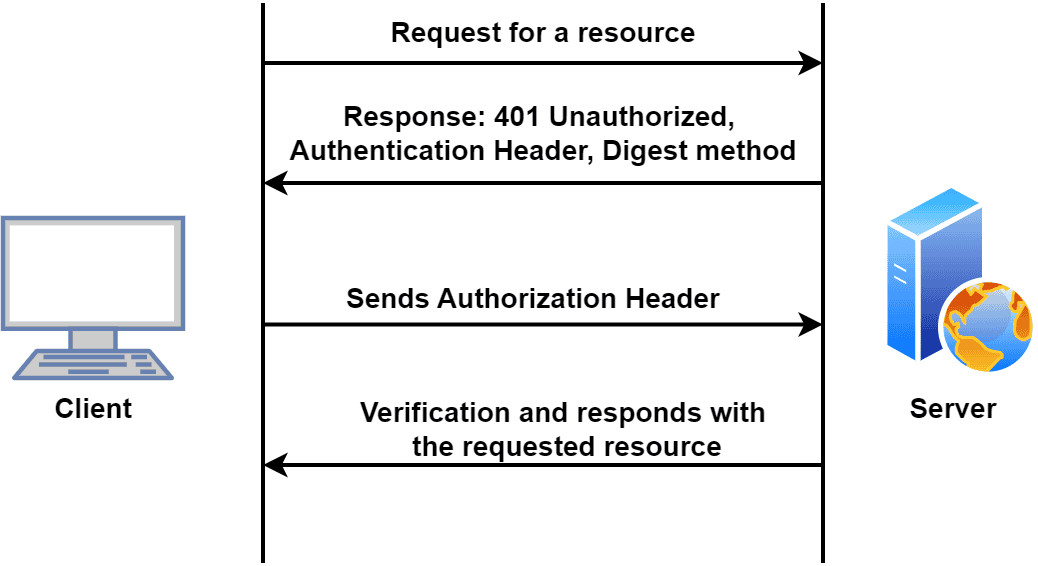
First, the client requests to access a file from a server. The server sends a response with a status code 401, asking for the authentication. Additionally, it also sends an authentication header which contains several information:
When the client receives the response from the server, it creates an authorization header containing the required information for authentication:
As soon as the server receives the authorization header from the client, it computes a hash value. If the hash value computed by the server matches the hash value sent from the client, the authentication is successful.
The digest authentication method boosts the security of the data transmission compared to the basic authentication method. Here, we calculate the hash value from the credentials and transfer the value to the server. Hence, it not only ensures the integrity of the data but also protects it from replay attacks.
Furthermore, the digest authentication method facilitates mutual authentication. In mutual authentication, the client and server authenticate each other. Therefore, we can ensure both parties are genuine.
One disadvantage of the digest authentication method is its complexity. The client and server need to implement the digest algorithm correctly. Additionally, as the digest algorithm runs on both the client and the server, it adds an overhead for communication.
Moreover, the digest authentication method uses HTTP for communication. HTTP is susceptible to cyber-attacks such as the man-in-the-middle (MITM) attack.
Now, let’s take a look at the main differences between the basic and digest authentication methods:
| Basic Authentication | Digest Authentication |
|---|---|
| Implementation is simple | Implementation is complex |
| The requirement for computation resources is minimal | Needs more resources as both the client and server implement the digest algorithm |
| Minimal performance overhead | Higher performance overhead due to hashing |
| The authentication process is faster | The authentication process is slower |
| Doesn’t provide any encryption | Provides hashing to boost security |
| Credentials transferred as plain text | Credentials transferred as a hash value |
| Vulnerable to replay attacks | Provides protection against replay attacks |
| Only used in low-security applications | Used for applications that need more security |
| Less flexible in terms of session management | Provides better support for session management |
In this article, we discussed two authentication techniques: basic and digest.
The basic authentication technique is easy to implement and fast. However, it’s vulnerable to cyber attacks as the credentials are transmitted as plain text without encryption.
On the other hand, the authentication technique enhances security by incorporating the digest method and sending a hash value instead of the credentials during communication.