
Learn through the super-clean Baeldung Pro experience:
>> Membership and Baeldung Pro.
No ads, dark-mode and 6 months free of IntelliJ Idea Ultimate to start with.
Last updated: June 17, 2023

Learn through the super-clean Baeldung Pro experience:
>> Membership and Baeldung Pro.
No ads, dark-mode and 6 months free of IntelliJ Idea Ultimate to start with.
In this tutorial, we’ll discuss maintainability killers and explore the role of smells and heuristics in avoiding maintainability killers.
Smells and heuristics are two tools used in software development to improve maintainability. Smells are code-level indicators of problems with a system’s design or implementation that can lead to maintainability issues. On the other hand, heuristics are general principles for designing and implementing software known to lead to maintainable systems.
Software development involves creating programs that are reliable, efficient, and maintainable. Maintainability is the characteristic of a software system that allows for easy modifications or updates to accommodate evolving requirements.
Maintainability is crucial for the long-term success of a software system. If a system is not maintainable, it can become difficult and expensive to modify, leading to technical debt, reduced reliability, and decreased efficiency.
Maintainability killers refer to factors or elements in software development that negatively impact the ease of maintaining and updating a software system over time. These factors can make modifying, debugging, or extending the software challenging, leading to increased costs and reduced efficiency. Ultimately, maintainability killers can threaten the long-term success of a software project.
Common maintainability killers include:
Code smells are warning signs in a software system’s design or implementation that suggest the presence of underlying problems. They often indicate that the system is not maintainable and may lead to technical debt or other issues if not addressed.
Code smells are indicators of suboptimal, questionable, or flawed code that may indicate deeper problems.
We must note that code smells are subjective and can vary based on the programming language, development methodologies, and team culture. However, identifying and addressing code smells can help improve the software’s quality, maintainability, and readability.
Some common code smells include:
Code smells can be identified and remedied in several ways, including:
Let’s consider a function that takes numerical data and counts all values greater than zero, sums them up, and finally computes and print out their average.
Before refactoring:
function processData(data):
    // INPUT
    //     data = list of values
    // OUTPUT
    //     prints the average of positive values in data

    sum <- 0
    count <- 0
    for value in data:
        if value > 0:
            sum <- sum + value
            count <- count + 1
    average <- sum / count
    print "Average:", average
After refactoring:
function processData(data):
    // INPUT
    //     data = list of values
    // OUTPUT
    //     prints the average of positive values in data

    sum <- getSumOfPositiveValues(data)
    count <- getCountOfPositiveValues(data)
    average <- sum / count
    print "Average:", average

function getSumOfPositiveValues(data):
    // Returns the sum of positive values in data

    sum <- 0
    for value in data:
        if value > 0:
            sum <- sum + value
    return sum

function getCountOfPositiveValues(data):
    // Returns the count of positive values in data

    count <- 0
    for value in data:
        if value > 0:
            count <- count + 1
    return count
In this example, the long method (the initial  function) has been refactored into three separate functions (or methods): ,
  , and
, and  . This makes the code easier to understand, test, and maintain, as each function now has a clear responsibility and can be modified independently of the others.
Heuristics are rules of thumb that are used to guide software development and improve the maintainability of a software system.
Examples of heuristics for maintainable software include:
First, let’s summarize the role of smells and heuristics:
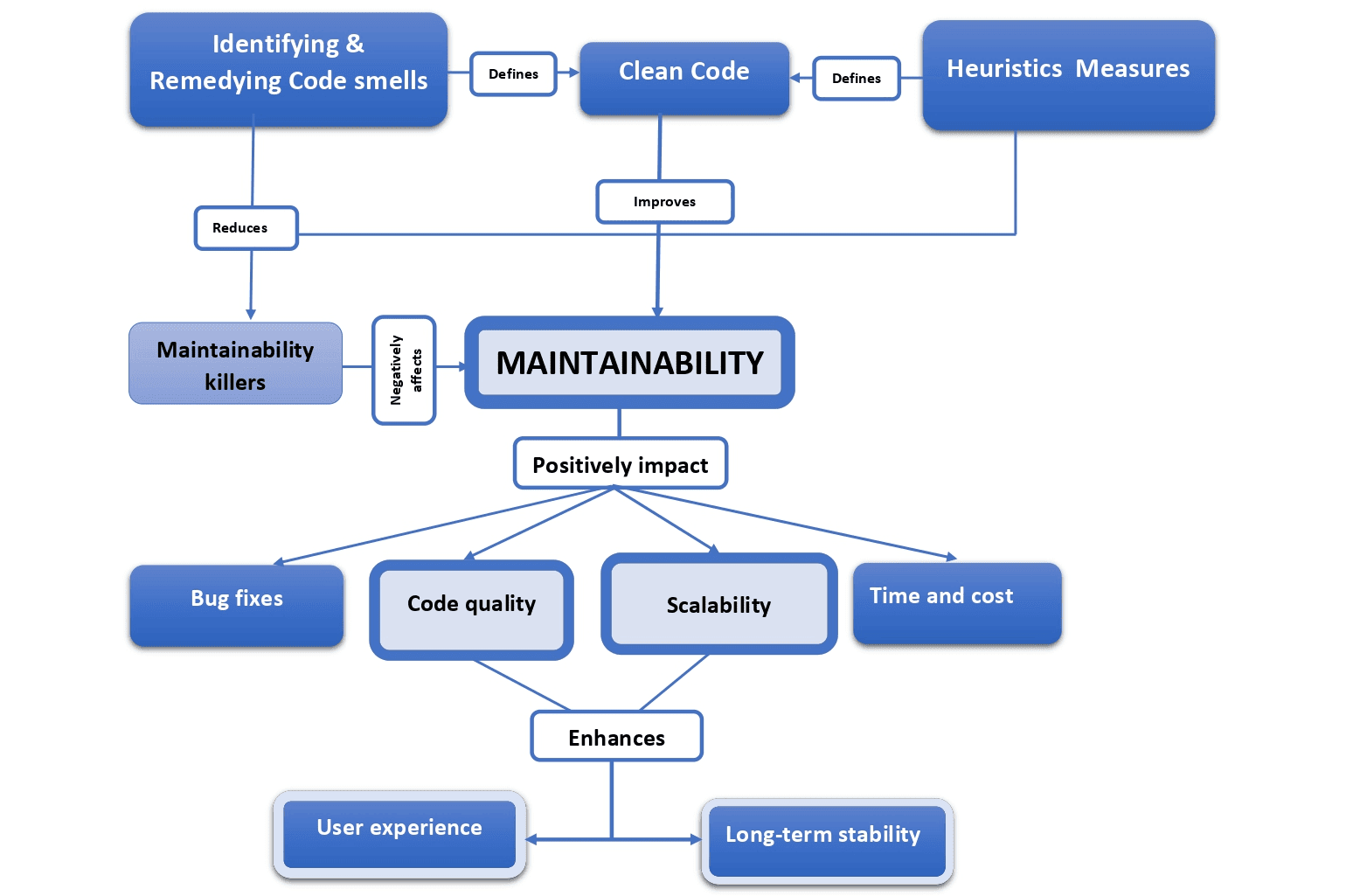
In software development, it is crucial to focus on maintainability to ensure the long-term success of a project. Smells and heuristics play a critical role in avoiding maintainability killers by helping developers identify potential problems early on and taking steps to correct them.
These tools allow developers to focus on writing clean, readable, and well-structured code. This can improve the overall quality and maintainability of the codebase. By regularly using these tools, developers can ensure that their code remains maintainable over time, even as the codebase grows and evolves.
In the end, the goal is to build software that can scale and adapt to meet the changing needs of the business, while minimizing the time and resources required to maintain it. Thus, the use of smells and heuristics can be seen as a crucial step in avoiding maintainability killers and promoting software that is both robust and scalable.
In this article, we talked about three important terms in software development – maintainability killers, smells, and heuristics.
Maintainability killers are serious problems in code that make it difficult to maintain. While code smells are patterns in the code that indicate potential problems. On the other hand, Heuristics are guidelines used to identify these issues and improve the maintainability of the code.