Mocking is an essential part of unit testing, and the Mockito library makes it easy to write clean and intuitive unit tests for your Java code.
Get started with mocking and improve your application tests using our Mockito guide:
Handling concurrency in an application can be a tricky process with many potential pitfalls. A solid grasp of the fundamentals will go a long way to help minimize these issues.
Get started with understanding multi-threaded applications with our Java Concurrency guide:
Spring 5 added support for reactive programming with the Spring WebFlux module, which has been improved upon ever since. Get started with the Reactor project basics and reactive programming in Spring Boot:
Since its introduction in Java 8, the Stream API has become a staple of Java development. The basic operations like iterating, filtering, mapping sequences of elements are deceptively simple to use.
But these can also be overused and fall into some common pitfalls.
To get a better understanding on how Streams work and how to combine them with other language features, check out our guide to Java Streams:
Explore Spring Boot 3 and Spring 6 in-depth through building a full REST API with the framework:
Yes, Spring Security can be complex, from the more advanced functionality within the Core to the deep OAuth support in the framework.
I built the security material as two full courses - Core and OAuth, to get practical with these more complex scenarios. We explore when and how to use each feature and code through it on the backing project.
You can explore the course here:
Spring Data JPA is a great way to handle the complexity of JPA with the powerful simplicity of Spring Boot.
Get started with Spring Data JPA through the guided reference course:
Refactor Java code safely — and automatically — with OpenRewrite.
Refactoring big codebases by hand is slow, risky, and easy to put off. That’s where OpenRewrite comes in. The open-source framework for large-scale, automated code transformations helps teams modernize safely and consistently.
Each month, the creators and maintainers of OpenRewrite at Moderne run live, hands-on training sessions — one for newcomers and one for experienced users. You’ll see how recipes work, how to apply them across projects, and how to modernize code with confidence.
Join the next session, bring your questions, and learn how to automate the kind of work that usually eats your sprint time.
Distributed systems often come with complex challenges such as service-to-service communication, state management, asynchronous messaging, security, and more.
Dapr (Distributed Application Runtime) provides a set of APIs and building blocks to address these challenges, abstracting away infrastructure so we can focus on business logic.
In this tutorial, we'll focus on Dapr's pub/sub API for message brokering. Using its Spring Boot integration, we'll simplify the creation of a loosely coupled, portable, and easily testable pub/sub messaging system:
1. Introduction
To run an application in an optimal way, JVM divides memory into stack and heap memory. Whenever we declare new variables and objects, call a new method, declare a String, or perform similar operations, JVM designates memory to these operations from either Stack Memory or Heap Space.
In this tutorial, we’ll examine these memory models. First, we’ll explore their key features. Then we’ll learn how they are stored in RAM, and where to use them. Finally, we’ll discuss the key differences between them.
2. Stack Memory in Java
Stack Memory in Java is used for static memory allocation and the execution of a thread. It contains primitive values that are specific to a method and references to objects referred from the method that are in a heap.
Access to this memory is in Last-In-First-Out (LIFO) order. Whenever we call a new method, a new block is created on top of the stack which contains values specific to that method, like primitive variables and references to objects.
When the method finishes execution, its corresponding stack frame is flushed, the flow goes back to the calling method, and space becomes available for the next method.
2.1. Key Features of Stack Memory
Some other features of stack memory include:
- It grows and shrinks as new methods are called and returned, respectively.
- Variables inside the stack exist only as long as the method that created them is running.
- It’s automatically allocated and deallocated when the method finishes execution.
- If this memory is full, Java throws java.lang.StackOverFlowError.
- Access to this memory is fast when compared to heap memory.
- This memory is threadsafe, as each thread operates in its own stack.
3. Heap Space in Java
Heap space is used for the dynamic memory allocation of Java objects and JRE classes at runtime. New objects are always created in heap space, and the references to these objects are stored in stack memory.
These objects have global access and we can access them from anywhere in the application.
We can break this memory model down into smaller parts, called generations, which are:
- Young Generation – this is where all new objects are allocated and aged. A minor Garbage collection occurs when this fills up.
- Old or Tenured Generation – this is where long surviving objects are stored. When objects are stored in the Young Generation, a threshold for the object’s age is set, and when that threshold is reached, the object is moved to the old generation.
- Permanent Generation – this consists of JVM metadata for the runtime classes and application methods.
These different portions are also discussed in the article Difference Between JVM, JRE, and JDK.
We can always manipulate the size of heap memory as per our requirement. For more information, visit this linked Baeldung article.
3.1. Key Features of Java Heap Memory
Some other features of heap space include:
- It’s accessed via complex memory management techniques that include the Young Generation, Old or Tenured Generation, and Permanent Generation.
- If heap space is full, Java throws java.lang.OutOfMemoryError.
- Access to this memory is comparatively slower than stack memory
- This memory, in contrast to stack, isn’t automatically deallocated. It needs Garbage Collector to free up unused objects so as to keep the efficiency of the memory usage.
- Unlike stack, a heap isn’t threadsafe and needs to be guarded by properly synchronizing the code.
4. Example
Based on what we’ve learned so far, let’s analyze a simple Java code to assess how memory is managed:
class Person {
    int id;
    String name;

    public Person(int id, String name) {
        this.id = id;
        this.name = name;
    }
}

public class PersonBuilder {
    private static Person buildPerson(int id, String name) {
        return new Person(id, name);
    }

    public static void main(String[] args) {
        int id = 23;
        String name = "John";
        Person person = null;
        person = buildPerson(id, name);
    }
}
Let’s analyze this step-by-step:
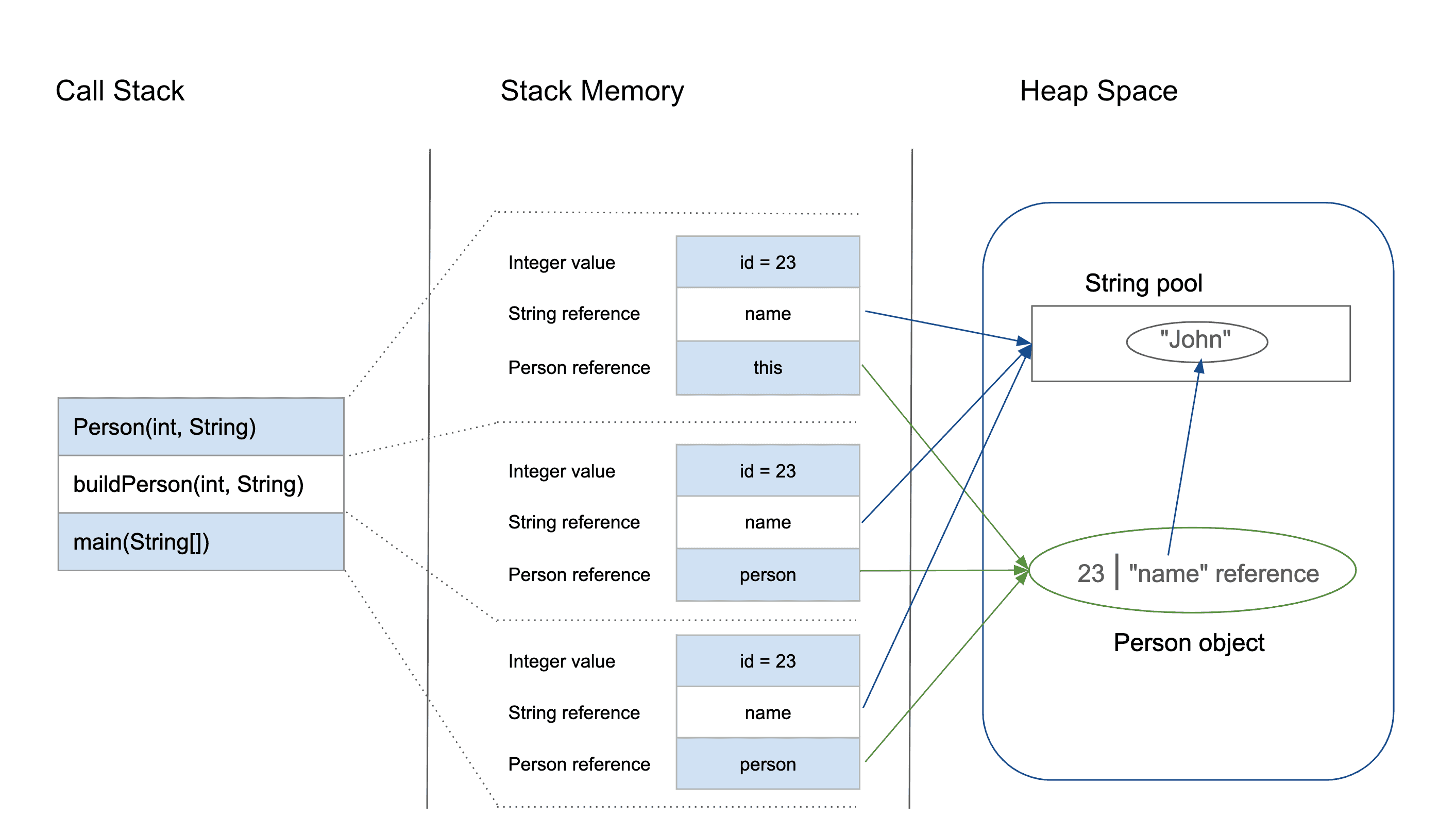
- When we enter the main() method, a space in stack memory is created to store primitives and references of this method.
- Stack memory directly stores the primitive value of the integer id.
- The reference variable person of type Person will also be created in stack memory, initially pointing to null and later updated to point to the actual object in the heap.
- The main method is calling the buildPerson() static method, for which allocation will take place in stack memory on top of the previous one.
- The buildPerson() calls the parameterized constructor Person(int, String) which will allocate further memory on top of the previous stack. This will store:
- The this object reference of the calling object in stack memory
- The primitive value id in the stack memory
- The reference variable of String argument name, which will point to the actual string from string pool in heap memory
- However, heap memory will store all instance variables for the newly created object person of type Person.
Let’s look at this allocation in the diagram below:
5. Summary
Before we conclude this article, let’s quickly summarize the differences between the Stack Memory and the Heap Space:
| Parameter | Stack Memory | Heap Space |
|---|---|---|
| Application | Stack is used in parts, one at a time during execution of a thread | The entire application uses Heap space during runtime |
| Size | Stack has size limits depending upon OS, and is usually smaller than Heap | There is no size limit on Heap |
| Storage | Stores only primitive variables and references to objects that are created in Heap Space | All the newly created objects are stored here |
| Order | It’s accessed using Last-in First-out (LIFO) memory allocation system | This memory is accessed via complex memory management techniques that include Young Generation, Old or Tenured Generation, and Permanent Generation. |
| Life | Stack memory only exists as long as the current method is running | Heap space exists as long as the application runs |
| Efficiency | Much faster to allocate when compared to heap | Slower to allocate when compared to stack |
| Allocation/Deallocation | This Memory is automatically allocated and deallocated when a method is called and returned, respectively | Heap space is allocated when new objects are created and deallocated by Gargabe Collector when they’re no longer referenced |
6. Conclusion
Stack and heap are two ways in which Java allocates memory. In this article, we learned how they work, and when to use them for developing better Java programs.
To learn more about Memory Management in Java, have a look at this article here. We also touched on the JVM Garbage Collector, which is discussed briefly over in this article.