


Learn through the super-clean Baeldung Pro experience:
>> Membership and Baeldung Pro.
No ads, dark-mode and 6 months free of IntelliJ Idea Ultimate to start with.
Last updated: March 18, 2024
Learn through the super-clean Baeldung Pro experience:
>> Membership and Baeldung Pro.
No ads, dark-mode and 6 months free of IntelliJ Idea Ultimate to start with.
Authentication is required to verify the identity of a user or a system that wants to access a web app. Additionally, to create secure web apps, session security is crucial. Further, because of the incorrect implementation of authentication, attackers can exploit and acquire unauthorized access.
In this tutorial, we’ll discuss popular authentication methods for web apps and best practices.
Authentication is necessary for a secured web application. Further, this is essential to give users superior experiences.
Let’s start by describing the numerous methods for achieving authentication:
Let’s now discuss which authentication method to Pick.
For SSO, OpenID has dominated the consumer sector. Furthermore, SAML is frequently the choice for many commercial applications.
Cookie- or token-based authentication is best for web-based applications. API-token authentication is better than cookie-based authentication to support both web and mobile.
In addition to the methods mentioned above, if necessary, we’ll use one-time passwords (OTP), multi-factor authentication (MFA), email verification, etc.
Let’s elaborate the steps for cookies based authentication as shown in below diagram:

Now, let’s discuss a few benefits and shortcomings of cookies-based authentication:
| Advantages | Disadvantages |
|---|---|
| Cookies use very little space | Cookies are vulnerable to XSS and CSRF attacks |
| Cookies are simple to use and apply | Scaling becomes a problem when many users log in |
| They also have the ability to revoke their validity | Contains sensitive information about the user, which makes them a target for attackers |
To avoid brute force assaults, the session ID should be long (128 bits) and generated randomly. The session ID should be free of any sensitive information pertaining to the user.
Further, the information should consist of a meaningless string of random characters. All session-based applications should use HTTPS communication.
The secure and HTTP-only properties are set when creating cookies. Keep sessions under control by deleting them when the browser is closed, a timeout occurs, the user logs out, or they log in from a different site.
JSON Web Tokens (JWTs) are the most widely used web app authentication method. Further, they are standalone tokens having usernames, roles, rights, etc.
The server creates a JWT and sends it to the client with secret information. With each subsequent request, the client sends the JWT stored on the client.
The server would then check the JWT with each request made by the client before responding. Additionally, the secret key to digitally sign JWTs guarantees the integrity and authenticity of the web app.
Now, let’s discuss a few benefits and shortcomings of token-based authentication:
| Advantages | Disadvantages |
|---|---|
| Server scalability is unaffected if number of users increases | The size of JWT is significantly larger than the session ID of a cookie |
| Stateless- the web application is not required to keep any session data on the server, hence reduce server load, improve performance and scalability | JWT cannot revoke access to a user |
| JWT contains more user information | Because a token is kept on the client side about the user, which makes them vulnerable for attackers |
| Portable- allowing cross-domain and cross-platform authentication and authorization | Theft-prone- if someone steals a JWT from a user or a system, they can use it to assume their identity and access their resources |
| Adaptable- include any information that is pertinent for the web app, allowing to control access in a precise and personalized way |
Let’s conclude by describing the best practices for achieving authentication using tokens:
Open Authentication (OAuth) and API-token expose APIs to systems outside their own.
API-token functions similarly to a JWT token and is sent via an Authorization header and processed by an API gateway to verify the user’s identity. Additionally, there is the option of using OAuth 1.0a or OAuth 2.0, a protocol that enables applications to log in to servers as users.
Google, Facebook, Twitter, and other companies use OAuth 2.0, which offers secured delegate access to a resource based on the user and relies on HTTPS for security. With the user’s consent, OAuth 2 enables the identity provider (IDP) to issue a token to these third-party applications. To access the resource on behalf of that user, the client utilizes the token.
To validate a user, OpenID, an HTTP-based protocol, utilizes an identity provider (IDP). IDP is responsible for protecting the user credentials.
Furthermore, IDP extends to other service providers a mechanism to implement Single Sign On (SSO) without the user’s input. Several websites that accept OpenID as an authentication method include Google, Facebook, WordPress, Yahoo, PayPal, and many more.
The most recent iteration of OpenID is called OpenID Connect, which adds OpenID (authentication) on top of OAuth 2.0 (authorization) for a security solution.
The below diagram shows a typical OpenID Connect process:
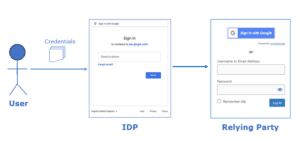
The relying party needs to be in direct touch with the IDP for a user to use the identity they shared with the third party. End-user authentication and providing end-user IDs to relying parties are the responsibilities of IDP.
While OpenID uses an IDP, SAML (Security assertion markup language) is XML-based and more versatile. SAML 2.0 is the latest version. Using the IDP URL, a user can log in to the system and have the system reroute them with XML data back to an application page. Furthermore, to obtain the user’s information, XML needs to be decoded.
SAML also offers a mechanism to implement SSO. Some SAML service providers are G Suite, Office 365, OneLogin, and Okta.
Let’s discuss the SAML process using the following diagram:

The identification service gives the service provider the user credential first. Next, each end user must log in using SSO just once for SAML parameters to be passed seamlessly to the service providers.
Furthermore, the service provider contacts IDPs to inquire about the authenticity of a request. The configuration of SAML SSO also requires permission during this process. This process guarantees the user authentication and authorization.
Web app authentication involves several methods, including cookies, JWT, OAuth, API Token, SAML, and OpenID. Depending on the use case and the security requirements, they have various advantages and downsides.
Now, let’s discuss a few benefits and shortcomings of commonly used authentication methods:
\
| Method | Pros | Cons |
|---|---|---|
| Cookies | Easy to implement and widely supported, keep session information, preferences, or other data to identify the user or customize the user experience | Vulnerable to CSRF attacks, add overhead to every request, limits size and number |
| JWT | Stateless, can carry more data, can support multiple domains or services, can be verified by anyone who has access to the key | Vulnerable to XSS attacks, have a fixed expiration time, cannot be revoked or refreshed easily |
| OAuth | Allows a user to grant access to their resources or data on one site to another site without sharing their credentials, can use different types of tokens, such as JWTs, API Tokens, or SAML assertions | Complex and requires multiple parties and interactions, introduces some security risks, such as phishing attacks, token leakage, or token replay |
| API Token | Simple and flexible, can have different formats and properties depending on the implementation and the security requirements | Vulnerable to interception or theft if not transmitted over HTTPS or stored securely and does not provide any information about the user or the application that is using them, make auditing or logging difficult |
| SAML | Allows a user to log in to one site and access another site without entering their credentials again, uses assertions that contain information about the user’s identity, attributes, or authorization decisions, can be signed and encrypted by the identity provider and verified by the service provider | Complex and requires XML processing and parsing, has some performance issues due to the size and number of messages involved |
| OpenID | Allows a user to log in to one site and use their identifier to access another site without creating an account or entering their credentials again, can use different types of tokens to represent the identity information | Complex and requires multiple parties and interactions, introduces some security risks, such as phishing attacks, identifier spoofing, or token leakage. |
In order to create secure web apps, session security is crucial. Without defense against external threats, a web application is not secure.
In this article, we’ll learn the crucial roles of methods in authentication for web applications and how to handle authentication on RESTful APIs.